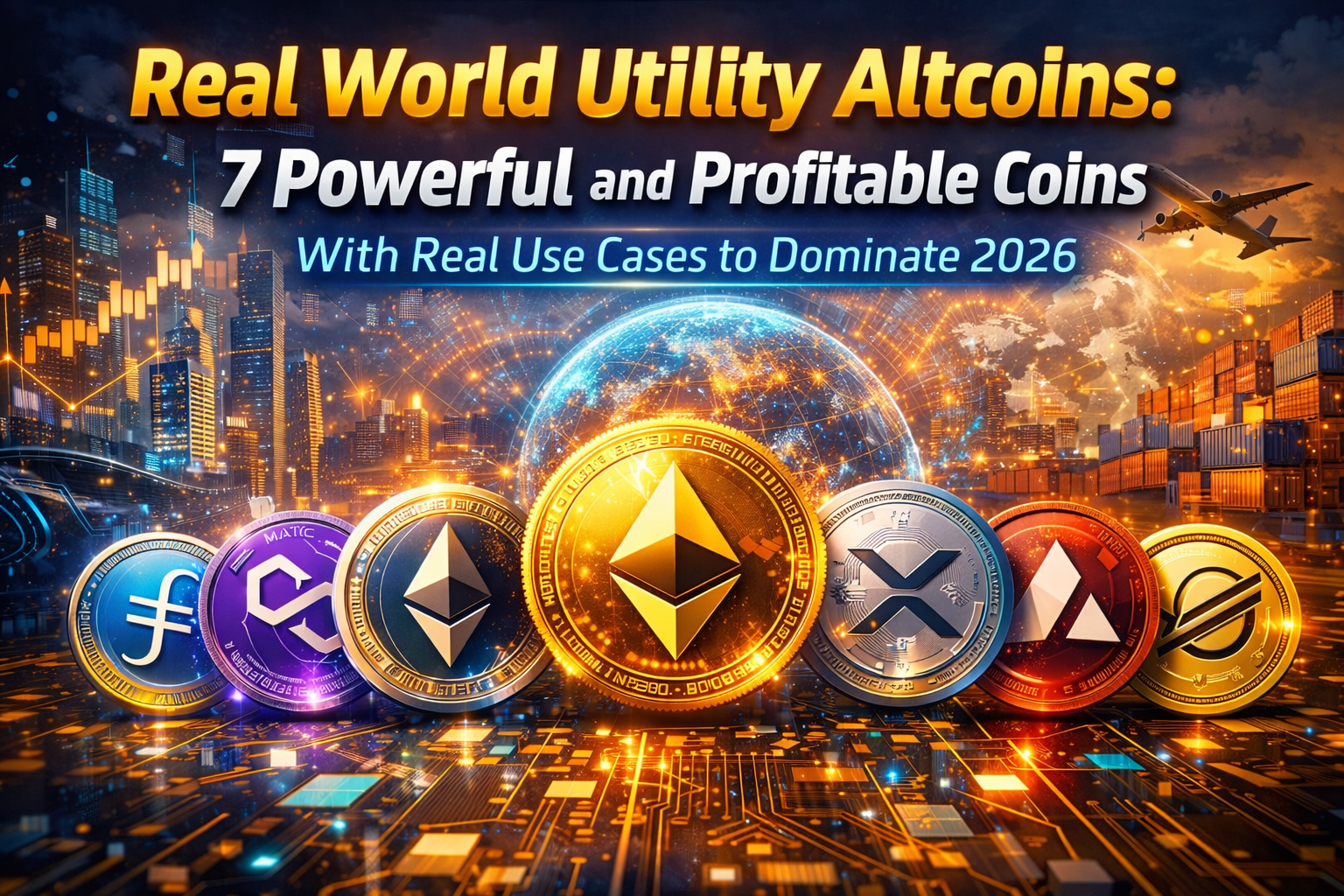
Why Real World Utility Altcoins Matter in 2026
In the ever-evolving world of cryptocurrency, the narrative has shifted. Gone are the days when investors chased meme coins and purely speculative tokens. Today, the market rewards real world utility altcoins — those that solve problems, enable services, and build infrastructure that people and businesses actually use.
These aren’t just digital assets you hope someone buys tomorrow. These are the best altcoins 2026 could be defined by, tokens that underpin real systems for payments, enterprise blockchain solutions, decentralized data feeds, and cross-border commerce. Understanding these assets now can give you both a practical and strategic edge for the coming years.
Before we dig into the 7 most powerful utility tokens of the emerging cycle, let’s unpack what makes an altcoin truly useful in the real world.
What Is a Real World Utility Altcoin?
At its core, a real world utility altcoin is a blockchain token that is more than a speculative investment. It must:
- Enable a tangible service or function
- Be used daily or regularly within a working ecosystem
- Provide utility beyond price speculation
- Integrate into systems people or companies depend on
This contrasts with tokens that derive value solely from trading momentum or expectations of price growth.
Here are some broad categories of real-world utility:
- Payments & Remittances – Fast, low-cost transfers across borders
- Decentralized Infrastructure – Networks like storage, computation, or data indexing
- Enterprise Blockchain Services – Blockchain solutions adopted by corporations
- Oracles & Data Feeds – Connecting on-chain applications with real-world information
Broad Categories of Real-World Utility in Cryptocurrency (Explained in Depth)
When people hear the phrase “real world utility altcoins,” it’s easy to assume it simply means any crypto that isn’t a meme coin. But true utility goes much deeper than that. Real-world utility in crypto refers to blockchain projects that actively solve existing problems, improve efficiency, or enable services that were previously slow, expensive, or impossible.
Let’s break down the four most important categories of real-world utility shaping the future of crypto adoption.
1. Payments & Remittances: Making Money Move Faster and Cheaper
One of the most powerful and visible real-world uses of cryptocurrency is payments, especially cross-border remittances.
Why this problem exists
Traditional international payments are:
- Slow (often taking days)
- Expensive (high fees, hidden exchange charges)
- Restricted (banking hours, geographic limitations)
For millions of people—especially migrants sending money home—this system is inefficient and unfair.
How crypto solves it
Payment-focused utility altcoins use blockchain networks to:
- Send value almost instantly
- Reduce fees drastically
- Remove reliance on intermediaries like correspondent banks
These networks operate 24/7, across borders, without asking permission from centralized institutions.
Real-world impact
- Migrant workers can send money home more cheaply
- Businesses can settle international invoices faster
- Emerging markets gain access to global finance without traditional banks
Examples of real utility
- Tokens designed for fast settlement
- Stablecoin-enabled payment rails
- Blockchain-based remittance networks
This is why payment and infrastructure altcoins with real world utility remain among the most practical and widely adopted crypto use cases in 2026.
2. Decentralized Infrastructure: The Backbone of Web3
If payments are the front door of crypto utility, decentralized infrastructure is the engine room.
What decentralized infrastructure means
In simple terms, this category includes blockchain projects that provide:
- Data
- Storage
- Computation
- Network coordination
These are the foundational services that allow decentralized applications (dApps) to function—similar to how cloud servers power traditional apps today.
Why infrastructure matters
Without infrastructure:
- DeFi platforms cannot access price data
- NFT platforms cannot store images securely
- dApps cannot function independently of centralized servers
Decentralized infrastructure replaces centralized providers (like traditional cloud companies) with permissionless, trust-minimized networks.
Real-world benefits
- Reduced censorship risk
- Increased transparency
- Greater system resilience
- No single point of failure
Why investors care
Infrastructure projects often:
- Generate consistent demand
- Serve multiple industries
- Become indispensable over time
This is why infrastructure-focused projects are often considered best altcoins with real world use cases for long term holding.
3. Enterprise Blockchain Solutions: When Corporations Adopt Crypto
One of the clearest signals of real-world utility is enterprise adoption.
What enterprise blockchain coins do
These altcoins provide blockchain solutions specifically designed for:
- Corporations
- Financial institutions
- Governments
- Large organizations
Instead of targeting retail traders, they focus on business efficiency, data integrity, and automation.
Problems enterprises face
- Complex supply chains
- Data silos
- Manual reconciliation
- High operational costs
- Lack of transparency
How blockchain helps
Enterprise blockchain platforms offer:
- Immutable records
- Automated workflows via smart contracts
- Transparent auditing
- Secure data sharing across departments
Real-world use cases
- Supply chain tracking
- Digital identity verification
- Asset tokenization
- Automated compliance
- Trade finance
These are not experimental ideas—they are live pilots and production systems, which is why enterprise blockchain coins are increasingly viewed as enterprise blockchain altcoins with real adoption in 2026.
4. Oracles & Data Feeds: Connecting Blockchains to the Real World
Blockchains are powerful—but isolated.
By design, a blockchain cannot access external information on its own. This creates a major limitation for smart contracts.
The problem
Smart contracts often need real-world data, such as:
- Asset prices
- Interest rates
- Weather conditions
- Sports results
- Shipping updates
Without accurate external data, smart contracts cannot function safely or reliably.
The solution: Oracles
Oracles are specialized networks that:
- Collect real-world data
- Verify its accuracy
- Deliver it securely to blockchains
This allows smart contracts to react to real-world events automatically.
Why this is critical
Without oracles:
- DeFi lending would collapse
- Derivatives markets wouldn’t function
- Insurance protocols couldn’t pay claims
- Enterprise blockchain systems would remain isolated
Real-world importance
Oracle networks are often:
- Used by multiple blockchains
- Embedded deeply into DeFi infrastructure
- Trusted by institutions
This makes oracle tokens some of the most structurally important crypto with real use cases, even if they don’t always get mainstream attention.
How These Categories Work Together
One of the most overlooked insights in crypto is that real-world utility categories don’t operate in isolation.
For example:
- Payment systems rely on infrastructure networks
- Enterprise solutions depend on oracles for data
- Storage networks support dApps and NFTs
- Infrastructure tokens enable payment scaling
In other words, utility compounds. The more these systems integrate, the stronger the overall ecosystem becomes.
This interconnectedness is exactly why real world utility altcoins tend to:
- Survive bear markets better
- Attract institutional interest
- Retain relevance across multiple market cycles

Utility Is the Difference Between Noise and Value
Speculation will always exist in crypto—but utility is what turns speculation into sustainability.
As we move deeper into 2026 and beyond, the projects that matter most won’t be the loudest ones. They’ll be the ones quietly:
- Power payments
- Secure data
- Support enterprises
- Enable decentralized systems
Understanding these categories doesn’t just make you a better investor—it makes you a more informed participant in the future of digital finance.
Common Mistakes to Avoid When Investing in Real World Utility Altcoins (2026 Guide)
As interest in real world utility altcoins grows, many investors assume that simply choosing any “utility” project guarantees success. Unfortunately, this is one of the biggest misconceptions in crypto.
While crypto with real use cases generally has stronger fundamentals than speculative tokens, poor judgment, shallow research, and emotional decision-making can still lead to losses. Understanding what not to do is just as important as knowing what to buy.
Below are the most critical mistakes to avoid if you want to identify the best altcoins 2026 has to offer and hold them with confidence.
1. Confusing “Promised Utility” With Real Adoption
One of the most common and costly mistakes is assuming that future potential equals current utility.
Why this is dangerous
Many projects claim they are building:
- Payment systems
- Enterprise blockchain solutions
- Infrastructure layers
But in reality:
- The product may still be on a roadmap
- There may be no real users
- Partnerships may be announcements, not implementations
What real utility actually looks like
True enterprise blockchain coins show:
- Active users
- On-chain activity
- Companies or institutions actually using the network
- Measurable demand for the token
How to avoid this mistake
- Look beyond whitepapers and marketing
- Check whether the platform is live
- Verify if real businesses or developers are using it
When evaluating the top real world utility altcoins to invest in 2026, adoption matters far more than ambition.
2. Ignoring Token Utility Within the Ecosystem
Another major mistake is failing to understand what the token actually does.
The hidden risk
Some projects have strong platforms, but:
- The token is not essential to the ecosystem
- Usage does not require holding the token
- Value accrues to the company, not token holders
This creates a disconnect between platform success and token price.
Why this matters for long-term investors
If a token is not:
- Required for fees
- Used for staking or governance
- Necessary for accessing services
Then its price may not reflect real adoption.
What to look for instead
The best altcoins with real world use cases for long term holding typically have:
- Tokens embedded into network operations
- Clear demand mechanisms
- Utility that scales with usage
Understanding token economics is essential when evaluating crypto with real use cases.
3. Overlooking Infrastructure and Focusing Only on “Popular” Coins
Many investors chase visibility instead of function.
The problem
Highly visible projects:
- Get more media attention
- Trend on social platforms
- Attract short-term hype
But some of the strongest payment and infrastructure altcoins with real world utility operate quietly in the background.
Why infrastructure is often undervalued
Infrastructure projects:
- Support multiple applications
- Serve entire ecosystems
- Are harder to replace once adopted
They may not trend daily, but they often generate consistent, long-term demand.
How to avoid this mistake
- Look for projects powering other platforms
- Study developer activity
- Evaluate real usage rather than social media buzz
Infrastructure is where long-term utility often compounds the most.
4. Assuming “Enterprise Blockchain” Automatically Means Profitable
Enterprise adoption is a strong signal — but it is not a guarantee of investor returns.
Common misunderstanding
Many assume that if corporations use a blockchain, the token must increase in value.
However:
- Some enterprise solutions operate on permissioned networks
- Token usage may be limited or indirect
- Revenue does not always flow to token holders
Smarter approach
When evaluating enterprise blockchain altcoins with real adoption in 2026, ask:
- Is the token required for enterprise usage?
- Does adoption increase on-chain activity?
- Is there a clear value capture mechanism?
Enterprise adoption matters — but how it translates to token demand matters even more.
5. Ignoring Regulatory and Jurisdictional Risks
Regulation is one of the most overlooked factors in utility-driven crypto investing.
Why this is risky
Projects focused on:
- Payments
- Remittances
- Financial infrastructure
Often operate in regulated environments.
Ignoring regulatory exposure can result in:
- Delistings
- Reduced adoption
- Sudden price shocks
How to manage this risk
- Monitor regulatory clarity in major markets
- Diversify across different utility categories
- Avoid overexposure to a single regulatory-sensitive sector
Strong real world utility altcoins are increasingly those that can coexist with regulation, not fight it.
6. Treating All Utility Tokens as Low-Risk
A dangerous assumption many investors make is that utility equals safety.
The truth
Even the best altcoins 2026 may experience:
- Volatility
- Market cycles
- Technology risks
- Competition
Utility reduces speculation — it does not eliminate risk.
Smarter mindset
- View utility as a risk-mitigating factor, not a guarantee
- Combine utility analysis with:
- Market trends
- Tokenomics
- Adoption metrics
Balanced expectations help you stay rational during market swings.
7. Failing to Think Long-Term With Real World Utility Altcoins
Perhaps the most ironic mistake is applying short-term trading psychology to long-term utility projects.
Why this happens
- Utility adoption takes time
- Infrastructure growth is gradual
- Enterprise onboarding moves slowly
This leads impatient investors to:
- Sell too early
- Chase faster hype cycles
- Miss compounding value
How to align strategy with utility
The best altcoins with real world use cases for long term holding reward:
- Patience
- Conviction
- Understanding of adoption timelines
If a project is solving real problems, value often emerges after infrastructure is built — not before.
8. Not Diversifying Across Utility Categories
Another subtle but serious mistake is concentrating only on one type of utility.
The risk
Focusing solely on:
- Payments
- Or enterprise
- Or infrastructure
Exposes you to sector-specific risks.
Better strategy
Diversify across:
- Payment networks
- Infrastructure platforms
- Enterprise blockchain solutions
- Data and oracle systems
This spreads risk while keeping your portfolio anchored in crypto with real use cases.
Utility Rewards Thinking, Not Guessing
The rise of real world utility altcoins marks a shift in crypto’s maturity. But utility only benefits those who:
- Understand it deeply
- Evaluate it critically
- Invest with patience and discipline
Avoiding these mistakes won’t guarantee profits — but it will dramatically reduce avoidable losses and position you to recognize genuine value.
In a market still filled with noise, hype, and shortcuts, utility is clarity. Those who learn to separate real adoption from storytelling are the ones most likely to benefit from the top real world utility altcoins to invest in 2026 and beyond.

Table: Comparison of 7 Real World Utility Altcoins to Watch in 2026
Here’s a snapshot of the key projects we’ll be discussing — what they do, their core utility, and why they’re poised for adoption in 2026 and beyond:
| Altcoin | Primary Use Case | Real World Utility | Area of Adoption |
|---|---|---|---|
| Ethereum (ETH) | Smart contracts & dApps | Backbone of DeFi & Web3 | Developer ecosystem |
| Chainlink (LINK) | Data oracles | Connects on-chain to off-chain data | DeFi & enterprise |
| Polygon (MATIC) | Layer 2 scaling | Low-fee transactions | Payments & Web3 apps |
| XRP (Ripple) | Cross-border payments | Bank & fintech remittances | Finance & payments |
| Stellar (XLM) | Financial access | Fast cost-effective remittances | NGOs, developing economies |
| Avalanche (AVAX) | Subnets & enterprise chains | Custom blockchain deployments | Enterprise adoption |
| Filecoin (FIL) | Decentralized storage | Web3 data storage & archives | Web3 infrastructure |
1. Ethereum (ETH): The Decentralized Backbone of Modern Blockchain Use
When people talk about real world utility altcoins, Ethereum is usually the first name that comes up — and for good reason. As the first blockchain to support smart contracts and decentralized applications (dApps), Ethereum powers thousands of use cases, from lending and staking to tokenized real-world assets.
Why Ethereum still leads:
- Smart contract platform: Virtually every decentralized finance (DeFi) protocol, NFT marketplace, and tokenized asset runs here.
- Layer 2 momentum: Scaling solutions (like Arbitrum and Optimism) are increasing transaction speed and affordability without sacrificing security.
- Institutional interest: Ethereum’s broad developer base and exposure via institutional products (like ETFs) continue to validate its long-term relevance.
In essence, ETH isn’t just another asset — it’s the infrastructure powering an entire decentralized economy.
2. Chainlink (LINK): The Oracle Infrastructure That Connects Blockchains to Reality
One of the most powerful examples of a crypto with real use cases is Chainlink. Unlike tokens that just exist for price speculation, LINK provides a critical infrastructure layer — secure data feeds that smart contracts rely on to function.
Here’s how it works:
- Smart contracts often need information from outside the blockchain (like price feeds, weather data, or supply data). Chainlink securely supplies this data.
- Its Cross-Chain Interoperability Protocol (CCIP) connects different blockchains, enabling data exchange and asset movement.
Why Chainlink matters:
- DeFi relies on accurate data: Without oracles, platforms like lending protocols and derivatives wouldn’t function.
- Institutional pilots: Financial institutions are testing tokenized assets and automated settlements using Chainlink.
- Real adoption: Bank partnerships and enterprise use cases bridge blockchain with traditional systems.
Chainlink’s role shows how utility tokens can become indispensable infrastructure — not just speculative assets.
3. Polygon (MATIC): Scaling for Payments and Web3 Experiences
Polygon has carved out a reputation as one of the top real world utility altcoins to invest in 2026, especially when it comes to payments and Web3 access.
What Polygon brings:
- Layer 2 scaling: It relieves congestion from Ethereum by enabling fast, low-fee transactions — a must for mass adoption.
- Enterprise and developer ecosystems: Companies like Disney, Reddit, and others have built smart token systems on Polygon.
- Stablecoin and payment initiatives: Recent partnerships support stablecoin payments infrastructure worth millions, indicating real payment utility.
Polygon exemplifies how payment and infrastructure altcoins with real world utility can attract both retail and institutional interest through practical utility rather than hype.
4. XRP (Ripple): Cross-Border Payments That Move Money Faster and Cheaper
For years, one of the strongest narratives in utility crypto has been Ripple’s XRP — especially in the realm of global payments.
Key points:
- Blockchain payments: RippleNet works with banks and payment providers to enable real-time, low-cost transfers.
- Financial inclusion: XRP’s use case extends to remittances and payments where traditional banking is slow or costly.
- Institutional relevance: Even amid regulatory noise, XRP maintains partnerships that demonstrate adoption.
XRP shows that a utility token can compete with legacy financial infrastructure, particularly where speed and cost matter most.
5. Stellar (XLM): Making Finance Accessible for All
Another project that embodies real utility on a global scale is Stellar.
Why Stellar matters:
- Banking the unbanked: Stellar simplifies cross-border remittances, especially in emerging economies where financial access is limited.
- Partnerships with fintechs and NGOs: These collaborations extend Stellar’s reach into markets that traditional finance often overlooks.
Where Stellar wins is in impact. Unlike many tokens that focus on trading narratives, XLM’s ecosystem is directly tied to moving money cheaply and inclusively — a core value of decentralized finance.
6. Avalanche (AVAX): Enterprise Blockchain Altcoin With Custom Deployments
Avalanche represents a newer category of utility tokens: enterprise blockchain coins that focus on customized deployments for businesses.
Avalanche’s strengths:
- Subnets: Custom blockchains running within the Avalanche ecosystem give enterprises flexibility and performance.
- Partnerships: Collaborations with organizations for secure, scalable blockchain solutions are expanding.
- Speed and efficiency: AVAX finalizes transactions rapidly, an advantage for applications that need real-time execution.
In the enterprise world, utility isn’t about hype or price — it’s about functionality and reliability. Avalanche is positioned to deliver exactly that.
7. Filecoin (FIL): Decentralized Storage for Web3 Data – A Foundational Utility
If you think about the practical building blocks of Web3, decentralized storage is right up there with computation and secure data feeds.
Filecoin checks these boxes:
- Data storage market: Filecoin turns unused storage into a utility layer for dApps and blockchain projects.
- Censorship resistance: Unlike centralized cloud providers, Filecoin’s decentralized model provides censorship-resistant storage.
- Use in real applications: From archival storage of NFT assets to large datasets, Filecoin brings real storage utility to blockchain developers.
This makes FIL one of the best altcoins with real world use cases for long term holding.
How to Evaluate Real World Utility Altcoins Before Investing
Not all utility tokens are created equal. Here’s how to vet projects before committing your capital:
1. Assess Actual Adoption
- Look for usage metrics: active users, transactions per day, partnerships
2. Real Products vs. Roadmaps
- Projects with MVPs or working infrastructures beat those with idea-only roadmaps
3. Developer and Ecosystem Activity
- Active developer contributions often signal long-term viability
4. Market Fit
- Does the token solve a real problem? If not, it’s speculation dressed as utility
5. Risk Management
- Always spread risk and do your own research — crypto markets are volatile
The Future of Utility Tokens — Why 2026 Could Be Strategic
As institutional interest grows and real adoption continues, utility tokens — not hype coins — are becoming the backbone of blockchain growth. Investors and builders alike are shifting focus toward:
- Infrastructure that bridges blockchain to real systems
- Payment rail innovation
- Enterprise blockchain adoption
Utility tokens that deliver useful technology and measurable adoption are more likely to endure market cycles and drive value.

Conclusion — A Practical Look at Navigating Crypto With Utility
Above all, investing in crypto — especially the top real world utility altcoins to invest in 2026 — isn’t just about price action. It’s about understanding impact.
Utility tokens like Ethereum, Chainlink, Polygon, XRP, Stellar, Avalanche, and Filecoin are not just assets — they are functional pieces of a decentralized future. They power payments, data, storage, enterprise applications, and decentralized systems used by developers, institutions, and everyday people.
In a crowded market full of speculation, these real use cases anchor long-term value and offer investors a foundation that goes beyond hype.
- Learn more about Ethereum and decentralized applications at the Ethereum Foundation — https://ethereum.org/
- Explore the role of crypto oracles and decentralized data at Chainlink’s official documentation — https://chain.link/